From panel drawings to a construction plan
ConstructiVision reads the panel drawings for a tilt-up job and plans the whole construction: where each panel is cast, where the crane starts, and every pick after that.
New: TIQ standings — every building ranked like a race by how little the crane drives, booms and swings per panel. Every scored reel now ends with its Tilt IQ sim report.
What you are watching
Starting from nothing but the panel drawings, ConstructiVision rebuilds the site: the grid, the walls, the slab with its closure strip, a footing under every panel and the wall clearance line. It lays each panel out to cast as near as it can to where that panel will stand, puts the crane where it can make the first pick, and then plans every pick in construction order.
Each video is that plan played back in AutoCAD, one frame per step: the crane moves to its station, the panel tilts up about its bottom edge, the crane swings it round itself to its footing and it is braced. These plans come from our development build. They are not yet in the released product.
The crane moves each panel the way a crawler crane does: it swings the load round at a constant radius, along one of its lift rings, and moves it in or out along the boom. It never carries a panel through its own body. The camera circles the site exactly once over the whole construction and looks across at the crane making each pick. The sky and sunlight are stand-ins chosen to resemble each site. Hills and trees are used for the 2020 Washington building. The 2017 and 2013 Washington buildings’ skies are 360° photographs, which light the scene as well as filling the background. The sun is placed for the site's real latitude and north.
Safety note: read before copying anything from these videos
Read the safety notes
SAFETY CORRECTION, 27 September 2026: in these videos the crane often reaches too far for the panel it lifts. Every pick must keep the panel’s centre of gravity inside its lift ring: the farthest radius at which the crane’s load chart still lifts that panel’s weight. These plans were checked against an LR 1300 chart that overstated the crane’s capacity 2.2 to 4.4 times, so the lift rings were drawn and checked much too far out. Against Liebherr’s published chart (LR 1300 data sheet 07/2008, page 13, 50 m main boom, 124 t + 57 t carbody counterweight, 360°), and before the hook block is deducted, these picks have the centre of gravity outside the lift ring. Each is marked in red in its video:
- Washington, 2013: 77 of 85 picks, the worst at 198% of the chart at that radius
- Washington, 2009: 37 of 77 picks, the worst at 158%
- Washington, 2020: 21 of 83 picks, the worst at 161%
- Washington, 2007 (68 panels): 4 of 68 picks, the worst at 171%
- Washington, 2007 (45 panels): 3 of 45 picks, the worst at 105%
- Washington, 2021: 1 of 46 picks, at 112%
- Washington, 2017: at least 2 of 61 picks, the worst at least 147% (planned before each pick’s radius was recorded; not marked in the video)
The “chart” figures printed in the videos came from the incorrect chart, and each “heaviest lift” below now shows the re-scored value. The chart is corrected in the software (CV-3050), and the planner now keeps every station at least two panel heights from the panel — one where two would put the panel outside its lift ring — and takes the closest such position. These buildings will be planned and filmed again.
A crawler crane must never stand with part of its tracks on the poured slab and part on the unpoured closure strip or ground along the slab edge. The support is uneven there, and the machine can go out of level under load.
The circles around the crane are its lift rings: the radii at which its load chart applies, drawn on the ground. They show how far the crane can reach, not where it stands. A lift ring may cross the slab edge. The track footprint, drawn as a rectangle under the crane, is what is checked against the slab edge.
What changed on 24 September, from your feedback. At every stop the crane's tracks now run parallel to the nearest wall. In the earlier videos most stops had them square to it. The track direction is part of the safety check, so every station was re-planned and re-checked, not just redrawn. The slab is also now one grey step darker than the panels, so a panel lying cast on it stands out. The panels are already pure white, so the slab could not go lighter. Both changes are in our development build and not yet in a release. They will be checked again on the released product.
Also changed on 24 September, from your feedback. The crane now swings each panel round itself on its lift rings instead of carrying it straight across, which in the earlier videos took most panels through the crane itself. The camera now circles the site. Neither change moves a crane station, so the check above still applies.
Earlier correction, 23 September. The ground drawn for the 2020 Washington building was off by up to 7¼ in at two corners. Measured against the true corners, one station in the first 2020 Washington video stood 4¼ in inside the 10 ft wall clearance, although it was 128 in clear of the slab edge. That video was replaced the same night and has been removed.
These plans illustrate the software. They are not lift plans. Every lift on a real job is planned and checked by a qualified lift planner against the crane manufacturer's chart and the site's actual ground conditions.
Watch a construction plan
Highlights · every safe pick from 18 buildings
Every pick that none of the plan’s safety checks flags, from each building on this page, best TIQ first. Each pick is shown whole, every step it was filmed with, at the same 12 frames a second as the reels. The high-risk picks are left out: the ones filmed in red, and in older reels the ones today’s checks flag. Each building’s own reel below shows them, and why. A building whose reel now ends with its QA check (83-panel-building, 78-panel-building, 37-panel-building-b, 52-panel-building, 37-panel-building, 38-panel-building, 59-panel-building, 61-panel-building, 68-panel-building, 77-panel-building) shows that check here too, right after its picks: each finding up close, numbered, then the building once round; where the 30 minutes run short, its worst findings only (78-panel-building 10 of 10, 52-panel-building 9 of 9, 38-panel-building 13 of 14, 59-panel-building 13 of 34, 61-panel-building 13 of 78, 68-panel-building 13 of 19, 77-panel-building 13 of 33) -- its own reel shows them all. 30 minutes; the highlights are capped at 30.
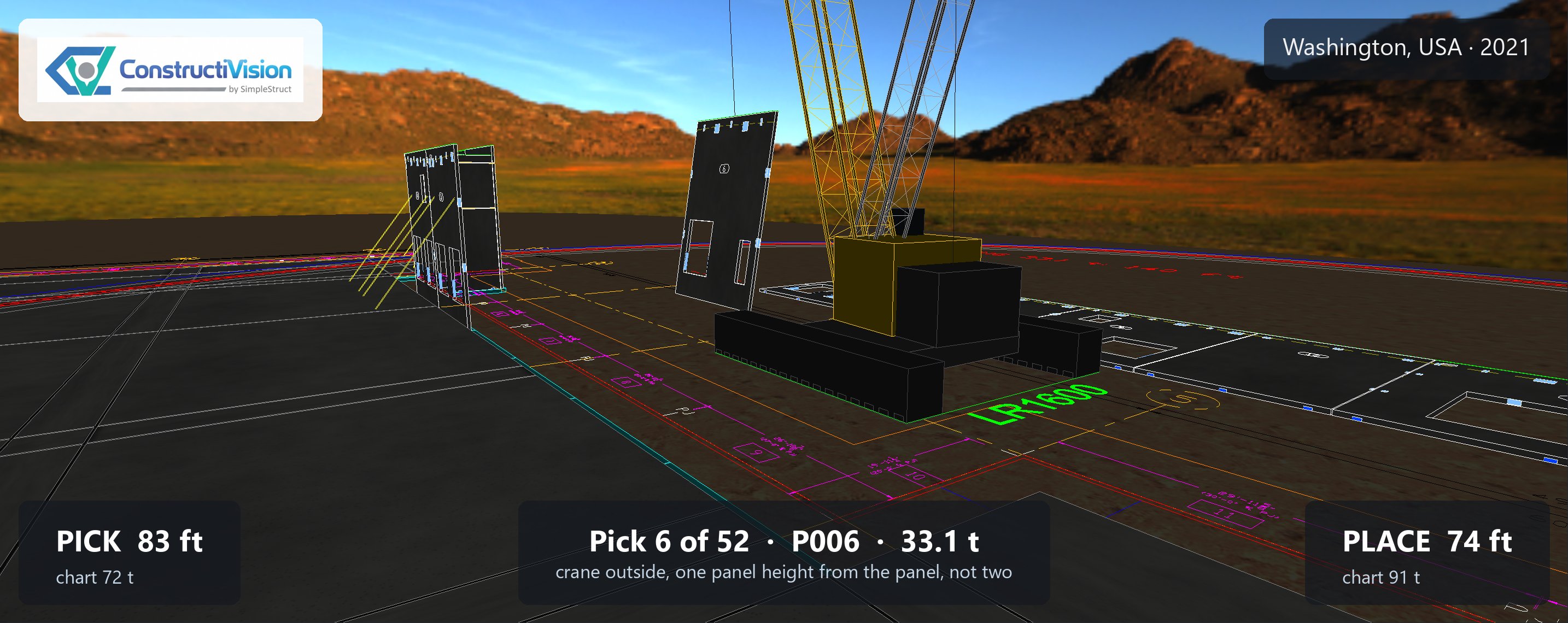 Play in the player above
Open the video (MP4, 2039 MB, full resolution)
Notes on this plan
What the checks catch
Three short clips of defects, shown on purpose. Each one is found by ConstructiVision’s own checks and drawn in red with what it costs the plan’s TIQ score. They are here to show what the checks see. Do not copy any of them: these plans illustrate the software, and every lift on a real job is planned and checked by a qualified lift planner against the crane manufacturer’s chart and the site’s actual ground conditions.
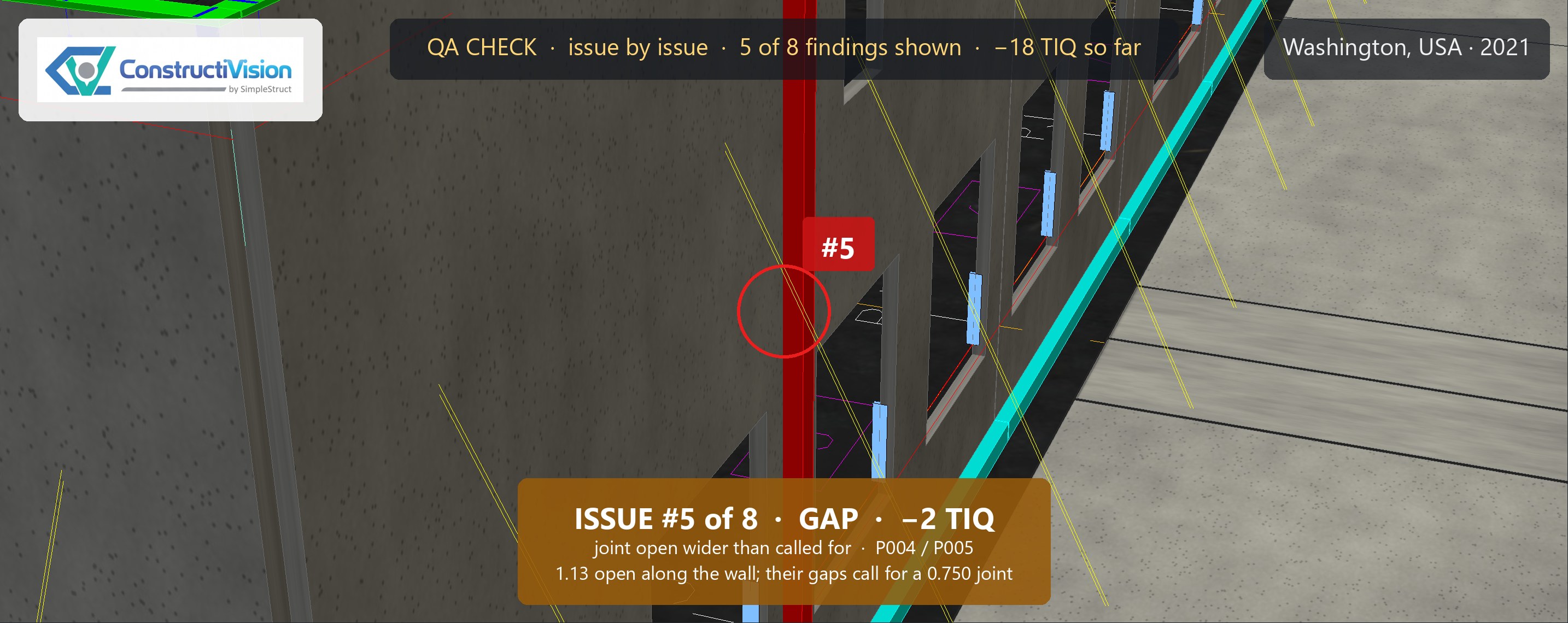
Caught by the QA check · a joint that does not close, beside a return
From the 83-panel Washington building (2021). Its return panel is set, then the two panels beside it, and the QA check at the end of the reel stops at the joint between those two: 1.13 in open where the panels’ own joint gaps call for 0.75 in. The wall does not close within tolerance there. 11 seconds.
 Play in the player above
Open the video (MP4, 9 MB, full resolution) · Download it
Notes on this plan
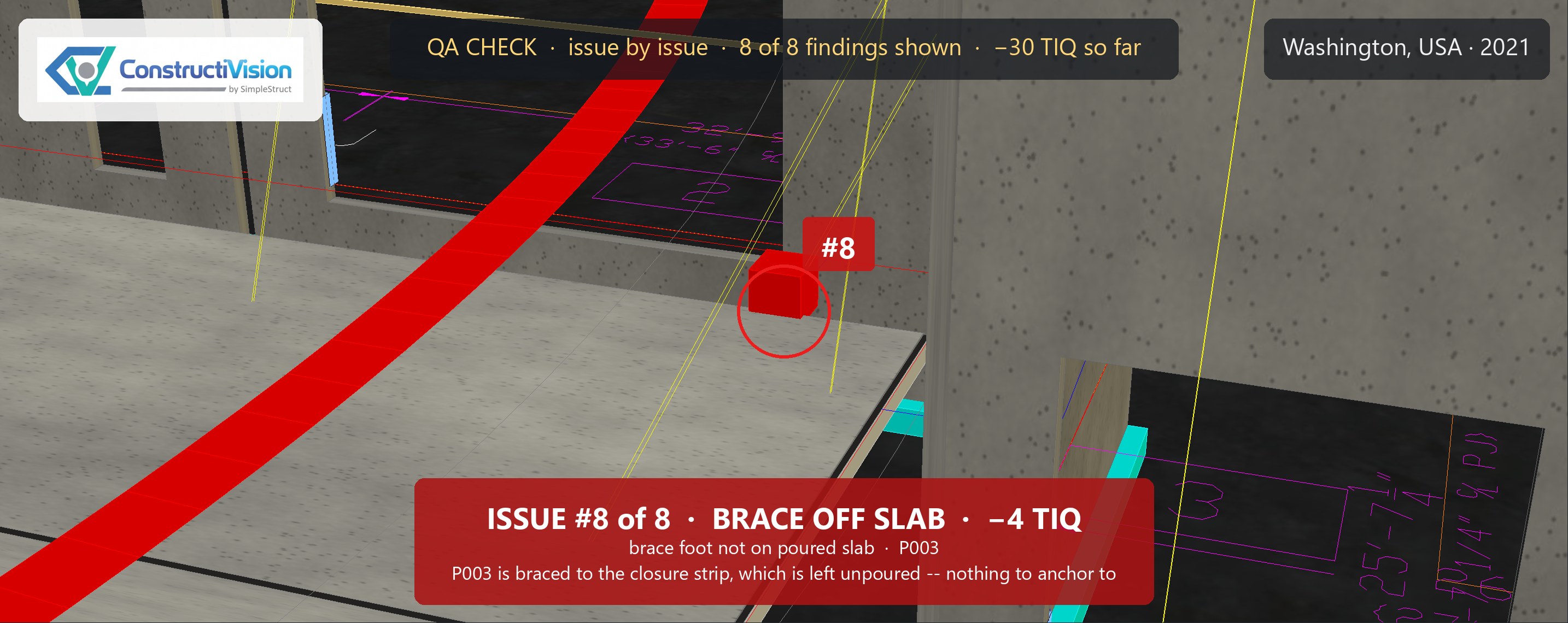
Caught by the QA check · braces that cross, and brace feet with nothing to anchor to
From the same reel. The QA check stops at the braces of two neighbouring corner panels passing 4 in apart, then at two panels braced into the closure strip. The closure strip is left unpoured, so there is no slab there to anchor a brace to. 14 seconds.
 Play in the player above
Open the video (MP4, 8 MB, full resolution) · Download it
Notes on this plan
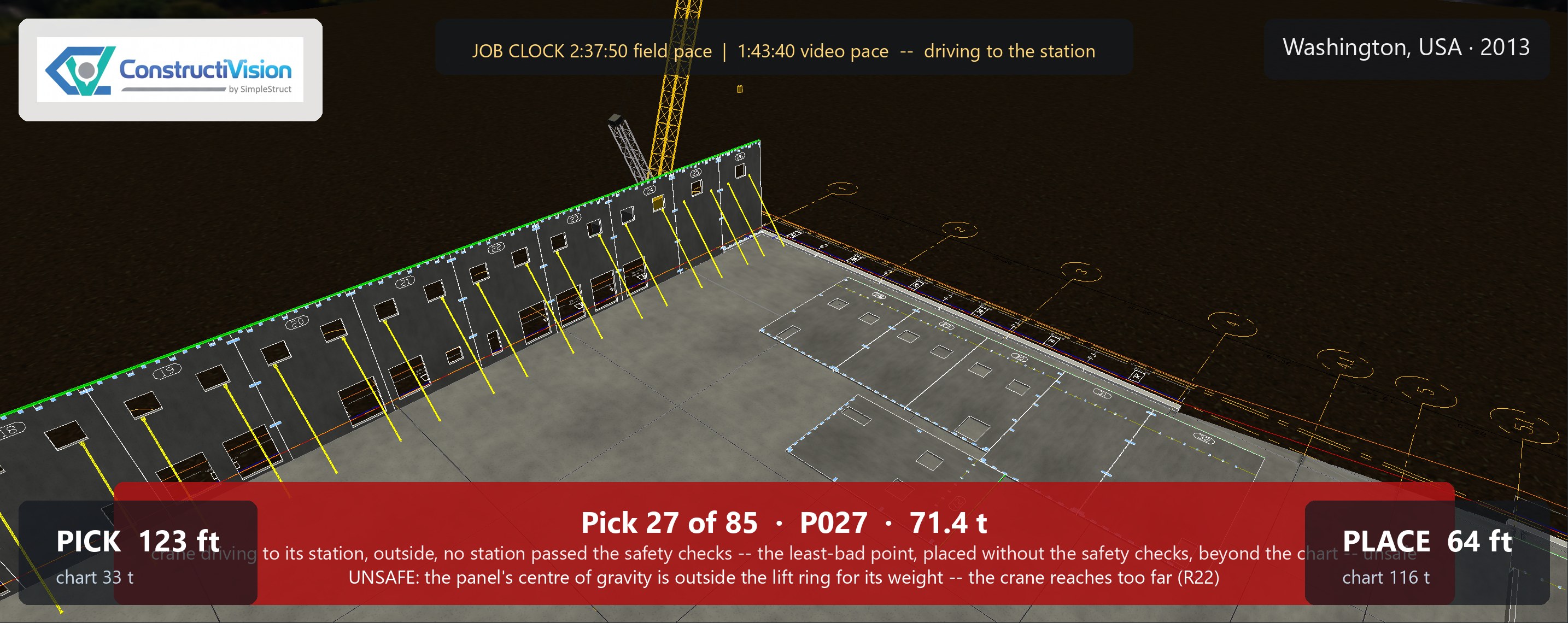
Flagged by the safety check · a lift beyond the crane’s chart
From a review plan of the 85-panel Washington building (2013) on an LR 1600 crawler. At pick 27 no crane position passed the safety checks, so the planner took the least-bad one and filmed the pick in red: the panel weighs 71.4 t and is picked at 123 ft, where the chart lifts 33 t. Its centre of gravity is outside the lift ring: the crane reaches too far. On a real job this lift is not made until the plan changes. The red pick plays at half speed. 12 seconds.
 Play in the player above
Open the video (MP4, 9 MB, full resolution) · Download it
Notes on this plan
What changed after it: the planner now tries each bigger crane it has a published chart for and keeps the plan with the fewest unsafe picks. On this building that is an MLC 650, with no pick over its chart. Both are in our development build, not yet in a release.
Washington, USA · 2020
A building of 83 panels, planned from a person's drawings: the erected site and the casting layout are the ones drawn for the job, not ones our software generated. An LR1600 crawler makes every pick. The camera turns once around the building, shared out wall by wall, so it keeps facing the wall being set, and rises to look straight down half way through.
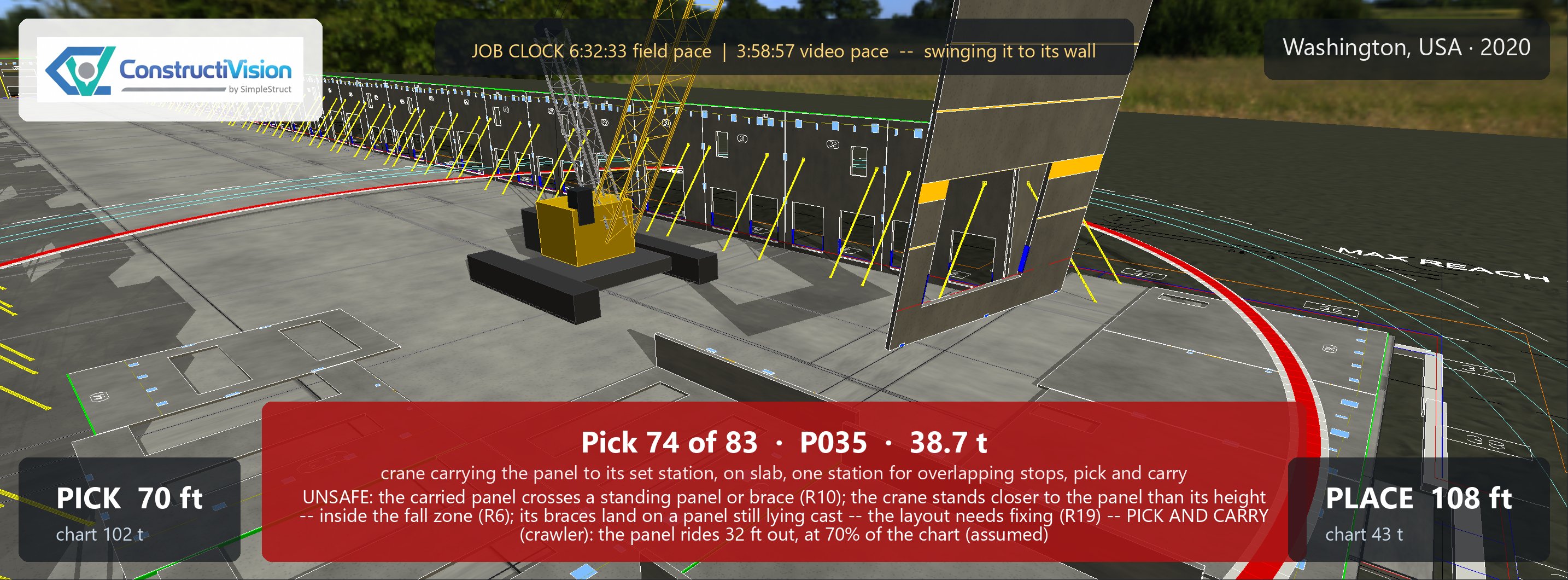 Play in the player above
Open the video (MP4, 433 MB, full resolution)
The earlier video of this building, kept to show what changed.
Safety notes: read before copying anything from this video
SAFETY: this plan breaks rules that kill the crew or damage the slab. The carried panel crosses a standing panel or brace at picks 74, 80, 83; the crane stands closer to the panel than its height, inside the fall zone at picks 1, 2, 3, 5, 9, 10, 13, 15, 16, 17, 19, 21, 22, 23, 24, 25, 26, 27, 28, 30, 31, 32, 33, 34, 35, 36, 37, 38, 39, 40, 41, 42, 43, 44, 45, 46, 47, 48, 49, 50, 51, 52, 53, 54, 55, 57, 58, 59, 60, 62, 63, 64, 68, 69, 70, 71, 74, 81; the tracks touch a standing panel, a brace or a cast panel while driving or turning at pick 73; a set panel's braces land on a panel still lying cast (the drawn layout needs fixing) at picks 72, 74, 78, 79; the tracks pivot or slide on the slab, which grinds the slab at picks 73, 78; on the slab, the tracks turn without travelling, or faster than 45 degrees per machine length at picks 73, 78, 82. Do not copy these picks. The red captions in the video name the rules checked when it was filmed. The planner is being fixed; a corrected reel will follow, and this one is kept to show the difference.
Not a sequence to copy where it breaks a safety rule: Picks 73, 82, 83 made from behind the panel being set, where the operator cannot see the load; 39 picks stand closer to the panel than the panel's height (1, 2, 3, 5, 9, 10, 13, 15, 16, 17, 19, 22, 23, 24, 25, 26, 27, 28, 32, 33, 34, 35, 36, 41, 42, 45, 46, 47, 48, 49, 50, 53, 54, 55, 57, 58, 62, 63, 64). Both are found by the plan's own checks, and neither is fixed in this video.
Washington, USA · 2017
A building of 61 panels, planned from a person's drawings: the erected site and the casting layout are the ones drawn for the job, not ones our software generated. An LR1600 crawler makes every pick. It starts outside the building and lifts the first 2 panels from there, each lift freeing a casting bed, then drives on to the slab: the way on is not clean -- no panel lying in its way could be lifted from outside, so it takes the least-touching way. The crane leaves through the building's own 254 ft opening, and the panel beside it is set last. The camera turns once around the building, shared out wall by wall, so it keeps facing the wall being set, and rises to look straight down half way through.
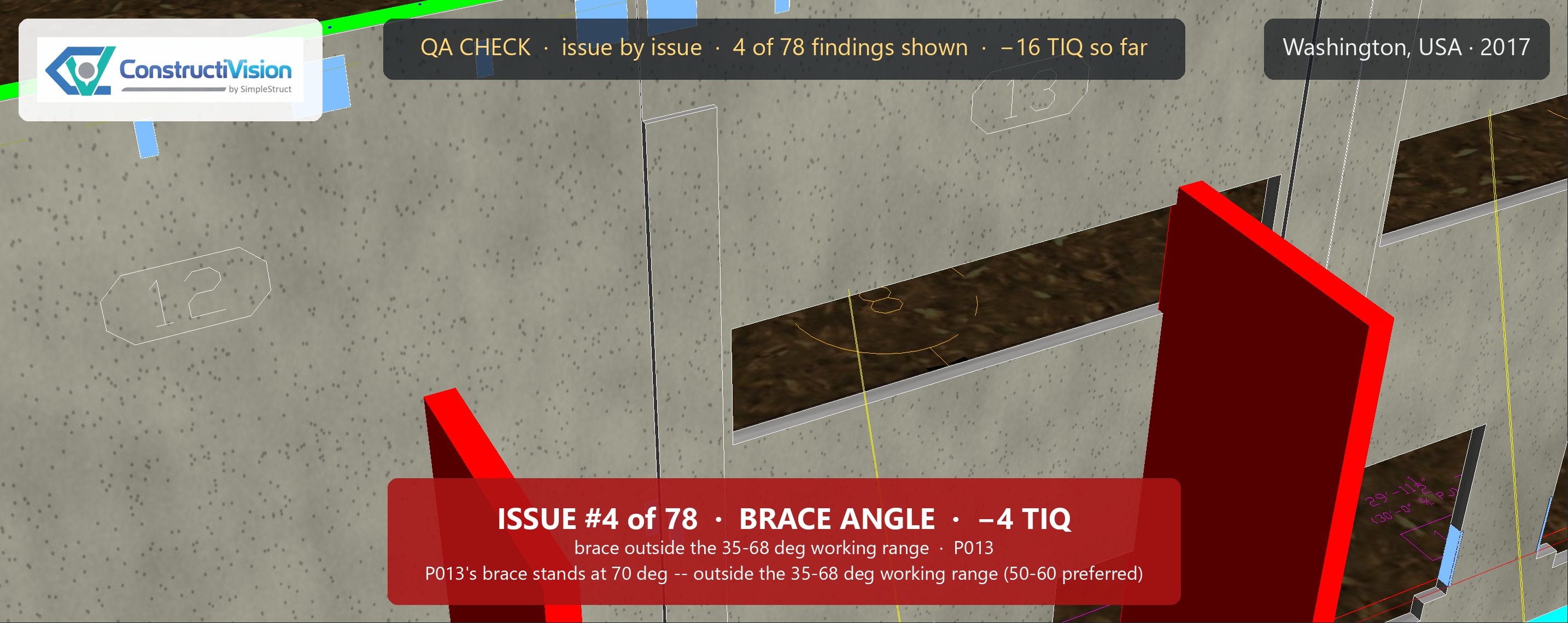 Play in the player above
Open the video (MP4, 418 MB, full resolution)
The earlier video of this building, kept to show what changed. Re-scored on 6 October, net of its 11.0 t hook block, against Liebherr’s published LR 1600/2 chart: 1 of 61 picks over the chart (worst 275%, at pick 3). That video was filmed before the hook block was deducted and may not mark it.
Safety notes: read before copying anything from this video
SAFETY: at 1 of 61 picks the crane reaches too far: the panel’s centre of gravity is outside its lift ring. A lift ring is the farthest radius at which the load chart still lifts the panel’s weight. Against Liebherr’s published LR 1600/2 chart (US technical data, page 25, 217 ft S boom, 419,000 + 143,300 lb counterweight, 360°), net of its 11.0 t hook block, as the chart requires, the worst is 275% of the chart at that radius. Outside the lift ring at pick 3; the video was filmed before this check deducted the hook block, so its red captions may name fewer of them.
SAFETY: this plan breaks rules that kill the crew or damage the slab. The carried panel crosses a standing panel or brace at pick 61; there is no hook room over the standing panels at pick 3; the crane stands closer to the panel than its height, inside the fall zone at picks 3, 4, 5, 6, 7, 18, 26, 27, 28, 31, 33, 34, 35, 36, 40, 41, 42, 44, 46, 48, 49, 61; the tracks touch a standing panel, a brace or a cast panel while driving or turning at picks 3, 4, 7, 27, 47; the panel’s centre of gravity is outside the lift ring for its weight (the crane reaches too far) at pick 3; the crane drives across the slab edge away from a ramp, with its tracks half on the slab and half off at pick 51. Do not copy these picks. The red captions in the video name the rules checked when it was filmed. The planner is being fixed; a corrected reel will follow, and this one is kept to show the difference.
Not a sequence to copy where it breaks a safety rule: Picks 1, 2, 33, 40 made from behind the panel being set, where the operator cannot see the load; 21 picks stand closer to the panel than the panel's height (4, 5, 6, 7, 18, 19, 26, 27, 28, 31, 33, 34, 35, 36, 40, 41, 42, 44, 46, 48, 49). Both are found by the plan's own checks, and neither is fixed in this video.
Washington, USA · 2013
A building of 85 panels. The erected site is the one drawn for the job; the casting layout is ConstructiVision's: the job's site record puts its panels on the far side of the building from their walls, so each panel is laid beside its own wall. An MLC650 makes every pick. The camera turns once around the building, shared out wall by wall, so it keeps facing the wall being set, and rises to look straight down half way through.
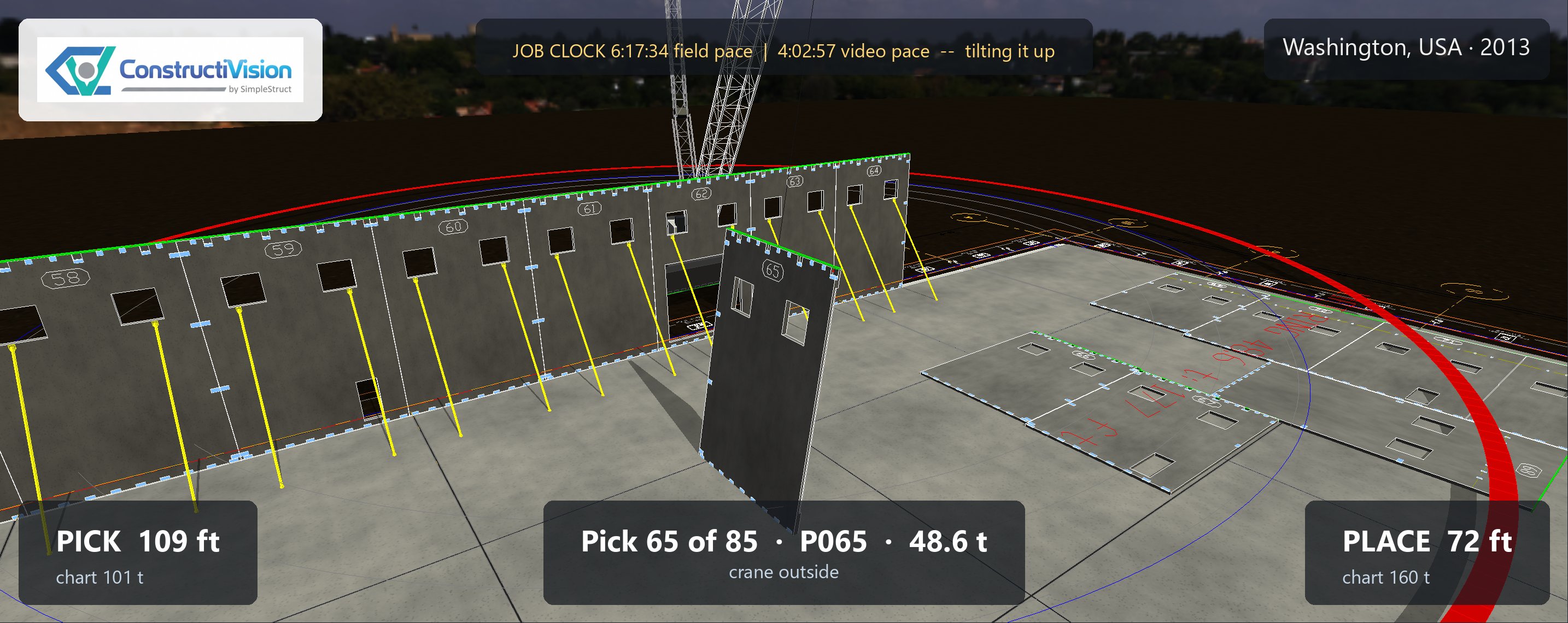 Play in the player above
Open the video (MP4, 338 MB, full resolution)
The earlier video of this building, kept to show what changed.
Safety notes: read before copying anything from this video
SAFETY: this plan breaks rules that kill the crew or damage the slab. The carried panel crosses a standing panel or brace at picks 84, 85; the boom crosses an erected panel at picks 26, 84, 85. Do not copy these picks. The red captions in the video name the rules checked when it was filmed. The planner is being fixed; a corrected reel will follow, and this one is kept to show the difference.
Not a sequence to copy where it breaks a safety rule: 1 pick stands closer to the panel than the panel's height (67). It is found by the plan's own checks and is not fixed in this video.
Washington, USA · 2021
A building of 46 panels, planned from a person's drawings: the erected site and the casting layout are the ones drawn for the job, not ones our software generated. An LR1300 crawler makes every pick. The crane leaves through the building's own 135 ft opening, and the panel beside it is set last. 3 panels no single crane position can reach are picked, carried while the crawler drives, and set from a second position (Evere017, Evere018, Evere019). The camera turns once around the building, shared out wall by wall, so it keeps facing the wall being set, and rises to look straight down half way through.
Open the video (MP4, 117 MB, full resolution)
Safety notes: read before copying anything from this video
SAFETY: at 6 of 46 picks the crane reaches too far: the panel’s centre of gravity is outside its lift ring. A lift ring is the farthest radius at which the load chart still lifts the panel’s weight. Against Liebherr’s published LR 1300 chart (data sheet 07/2008, page 13, 50 m main boom, 124 t + 57 t carbody counterweight, 360°), net of its 5.5 t hook block, as the chart requires, the worst is 146% of the chart at that radius. The chart this plan was made with overstated the crane several times over (CV-3050). Outside the lift ring at picks 3, 25, 26, 36, 40, 41; the video was filmed before this check deducted the hook block, so its red captions may name fewer of them.
SAFETY: this plan breaks rules that kill the crew or damage the slab. The carried panel crosses a standing panel or brace at picks 18, 19, 36, 37, 39, 40, 41, 42; the boom crosses an erected panel at pick 41; there is no hook room over the standing panels at pick 18; the panel’s centre of gravity is outside the lift ring for its weight (the crane reaches too far) at picks 3, 25, 26, 36, 40, 41. Do not copy these picks. The red captions in the video name the rules checked when it was filmed. The planner is being fixed; a corrected reel will follow, and this one is kept to show the difference.
Safety check on this plan. The same independent check as above, with its crane-across-the-edge control caught first: all 49 crane positions are clear, 0 wholly on poured slab inside the closure strip and 49 wholly outside beyond the wall clearance. None is on the closure strip or across the slab edge. The closest is 166 in from the slab edge. The picks named in the SAFETY note above break the carry and boom rules.
The sky is a photograph. A 360° photo (Poly Haven, CC0) is the scene's lighting as well as its background, so it turns with the camera. It is not the site's real surroundings. The ground around the site is cut from the photo's own terrain and matched to its colour as it renders; beyond it the photo's own ground shows.
Still open: Some carries still touch a standing panel or brace briefly.
Washington, USA · 2007
A building of 45 panels, planned from a person's drawings: the erected site and the casting layout are the ones drawn for the job, not ones our software generated. An LR1300 crawler makes every pick. It starts outside the building and lifts the first 17 panels from there, each lift freeing a casting bed, then drives on to the slab over a way that crosses nothing. The camera turns once around the building, shared out wall by wall, so it keeps facing the wall being set, and rises to look straight down half way through.
Open the video (MP4, 129 MB, full resolution)
Safety notes: read before copying anything from this video
SAFETY: at 8 of 45 picks the crane reaches too far: the panel’s centre of gravity is outside its lift ring. A lift ring is the farthest radius at which the load chart still lifts the panel’s weight. Against Liebherr’s published LR 1300 chart (data sheet 07/2008, page 13, 50 m main boom, 124 t + 57 t carbody counterweight, 360°), net of its 5.5 t hook block, as the chart requires, the worst is 129% of the chart at that radius. The chart this plan was made with overstated the crane several times over (CV-3050). Outside the lift ring at picks 15, 29, 33, 34, 35, 36, 42, 45; the video was filmed before this check deducted the hook block, so its red captions may name fewer of them.
SAFETY: this plan breaks rules that kill the crew or damage the slab. The carried panel crosses a standing panel or brace at pick 42; the crane stands closer to the panel than its height, inside the fall zone at pick 27; the tracks touch a standing panel, a brace or a cast panel while driving or turning at picks 26, 37, 45; a set panel's braces land on a panel still lying cast (the drawn layout needs fixing) at picks 2, 3, 8, 9, 10, 13, 20, 22, 23, 40, 44; the tracks pivot or slide on the slab, which grinds the slab at picks 27, 28, 34, 35, 37, 43, 44; the tracks turn without travelling, or faster than 30 degrees per machine length at picks 26, 27, 28, 34, 35, 37, 43, 44, 45; the panel’s centre of gravity is outside the lift ring for its weight (the crane reaches too far) at picks 15, 29, 33, 34, 35, 36, 42, 45. Do not copy these picks. The red captions in the video name the rules checked when it was filmed. The planner is being fixed; a corrected reel will follow, and this one is kept to show the difference.
Not a sequence to copy where it breaks a safety rule: Picks 5, 6, 7, 8, 9, 15, 16, 17, 18, 19, 20, 21, 22, 23, 24, 41 made from behind the panel being set, where the operator cannot see the load; 9 picks stand closer to the panel than the panel's height (1, 2, 3, 4, 6, 8, 10, 11, 27). Both are found by the plan's own checks, and neither is fixed in this video.
Safety check on this plan. The same independent check as above, with its crane-across-the-edge control caught first: all 45 crane positions are clear, 19 wholly on poured slab inside the closure strip and 26 wholly outside beyond the wall clearance. None is on the closure strip or across the slab edge. The closest is 132 in from the slab edge. The picks named in the SAFETY note above break the carry and boom rules.
The sky is a photograph. A 360° photo (Poly Haven, CC0) is the scene's lighting as well as its background, so it turns with the camera. It is not the site's real surroundings. The ground around the site is cut from the photo's own terrain and matched to its colour as it renders; beyond it the photo's own ground shows.
Still open: 3 of the 45 drives between stations cannot avoid everything; the least-touching way is used each time; some carries still touch a standing panel or brace briefly.
Washington, USA · 2007
A building of 68 panels, planned from a person's drawings: the erected site and the casting layout are the ones drawn for the job, not ones our software generated. An LR1600 crawler makes every pick. The camera turns once around the building, shared out wall by wall, so it keeps facing the wall being set, and rises to look straight down half way through.
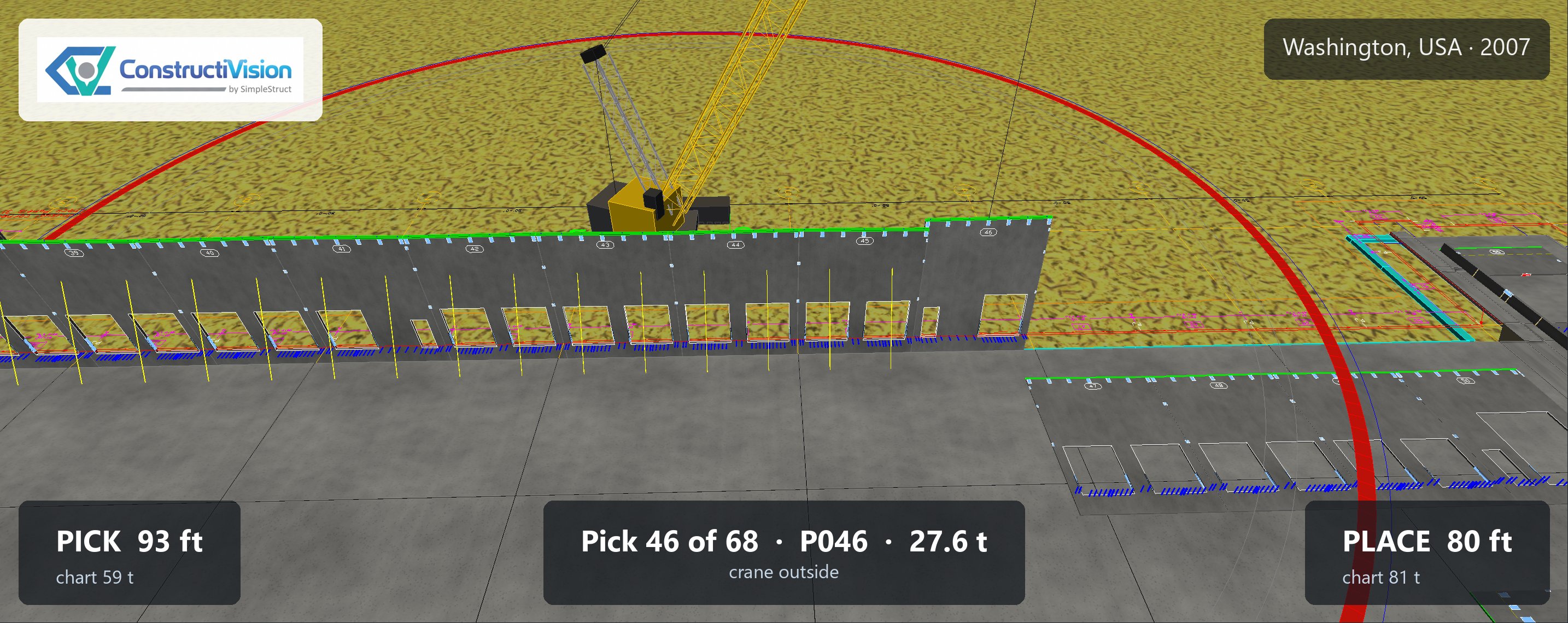 Play in the player above
Open the video (MP4, 318 MB, full resolution)
The earlier video of this building, kept to show what changed. Re-scored on 6 October, net of its 5.5 t hook block, against Liebherr’s published LR 1300 chart: 9 of 68 picks over the chart (worst 222%, at picks 5, 23, 29, 31, 42, 47, 51, 56, 58). That video was filmed before the hook block was deducted and may not mark them.
Safety notes: read before copying anything from this video
SAFETY: at 2 of 68 picks the crane reaches too far: the panel’s centre of gravity is outside its lift ring. A lift ring is the farthest radius at which the load chart still lifts the panel’s weight. Against Liebherr’s published LR 1600/2 chart (US technical data, page 25, 217 ft S boom, 419,000 + 143,300 lb counterweight, 360°), net of its 11.0 t hook block, as the chart requires, the worst is 269% of the chart at that radius. Outside the lift ring at picks 29, 51; the video was filmed before this check deducted the hook block, so its red captions may name fewer of them.
SAFETY: this plan breaks rules that kill the crew or damage the slab. The carried panel crosses a standing panel or brace at pick 68; the boom crosses an erected panel at pick 29; there is no hook room over the standing panels at picks 51, 52; a set panel's braces land on a panel still lying cast (the drawn layout needs fixing) at picks 4, 5, 6, 7, 8, 9, 10, 11, 12, 13, 14, 16, 17, 18, 19, 20, 21, 30, 31; the panel’s centre of gravity is outside the lift ring for its weight (the crane reaches too far) at picks 29, 51. Do not copy these picks. The red captions in the video name the rules checked when it was filmed. The planner is being fixed; a corrected reel will follow, and this one is kept to show the difference.
Not a sequence to copy where it breaks a safety rule: 2 picks stand closer to the panel than the panel's height (34, 52). It is found by the plan's own checks and is not fixed in this video.
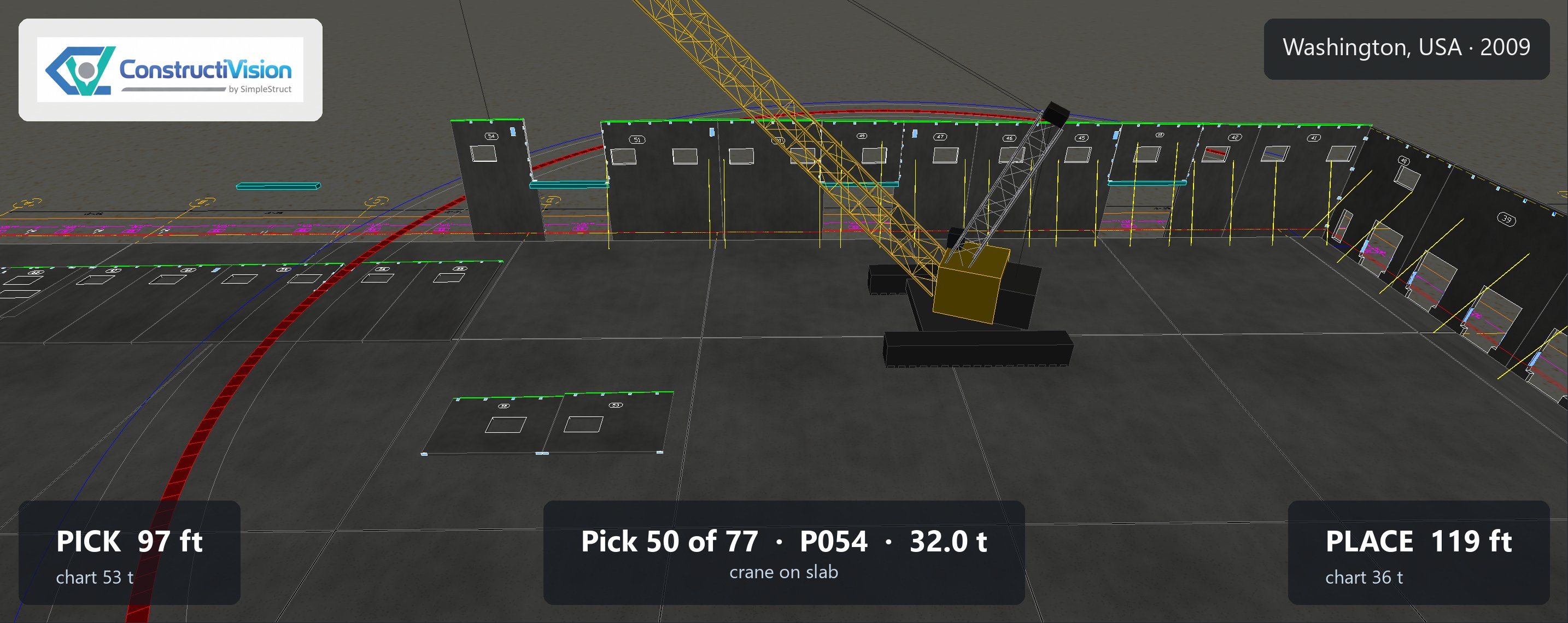
Washington, USA · 2009
A building of 77 panels, planned from a person's drawings: the erected site and the casting layout are the ones drawn for the job, not ones our software generated. An LR1600 crawler makes every pick. The camera turns once around the building, shared out wall by wall, so it keeps facing the wall being set, and rises to look straight down half way through.
 Play in the player above
Open the video (MP4, 306 MB, full resolution)
The earlier video of this building, kept to show what changed. Re-scored on 6 October, net of its 5.5 t hook block, against Liebherr’s published LR 1300 chart: 53 of 77 picks over the chart (worst 205%, at picks 1, 2, 3, 4, 5, 7, 8, 9, 11, 13, 14, 15, 16, 18, 20, 21, 23, 24, 25, 26, 27, 29, 31, 33, 34, 35, 36, 37, 38, 40, 41, 42, 47, 49, 50, 54, 56, 57, 58, 59, 61, 62, 63, 65, 66, 68, 69, 70, 73, 74, 75, 76, 77). That video was filmed before the hook block was deducted and may not mark them.
Safety notes: read before copying anything from this video
SAFETY: this plan breaks rules that kill the crew or damage the slab. The carried panel crosses a standing panel or brace at picks 33, 77; there is no hook room over the standing panels at pick 19; the tracks touch a standing panel, a brace or a cast panel while driving or turning at picks 2, 6, 10, 75; a set panel's braces land on a panel still lying cast (the drawn layout needs fixing) at picks 9, 10, 12, 13, 14, 15, 16, 17, 18, 21, 23, 24, 25, 26, 27, 28, 29, 30. Do not copy these picks. The red captions in the video name the rules checked when it was filmed. The planner is being fixed; a corrected reel will follow, and this one is kept to show the difference.
Not a sequence to copy where it breaks a safety rule: Picks 75, 76, 77 made from behind the panel being set, where the operator cannot see the load; 2 picks stand closer to the panel than the panel's height (19, 41). Both are found by the plan's own checks, and neither is fixed in this video.
Taurus-Littrow, the Moon · 2030
A building of 46 panels, planned from the job's own records: the casting layout is the one drawn for the job; the erected site is stood up from the panel positions recorded in the job's own site drawing. Neither was generated by our planner. An LR1300 crawler makes every pick. Filmed against the Moon: the backdrop is NASA's Apollo 17 panorama of the Taurus-Littrow valley (public domain; stitched by the Lunar and Planetary Institute). The building and its plan are the job's own, from Earth. NASA does not endorse this video. The crane leaves through the building's own 135 ft opening, and the panel beside it is set last. The camera turns once around the building, shared out wall by wall, so it keeps facing the wall being set, and rises to look straight down half way through.
Open the video (MP4, 121 MB, full resolution)
Safety notes: read before copying anything from this video
SAFETY: this plan breaks rules that kill the crew or damage the slab. The carried panel crosses a standing panel or brace at picks 29, 40, 41, 46; there is no hook room over the standing panels at pick 18; a set panel's braces land on a panel still lying cast (the drawn layout needs fixing) at picks 1, 2, 11, 12, 13, 14, 15, 16, 17, 18, 23, 27, 29, 30, 31, 32, 33, 36, 37, 38, 39. Do not copy these picks. The red captions in the video name the rules checked when it was filmed. The planner is being fixed; a corrected reel will follow, and this one is kept to show the difference.
Not a sequence to copy where it breaks a safety rule: 3 picks stand closer to the panel than the panel's height (16, 18, 45). It is found by the plan's own checks and is not fixed in this video.
Safety check on this plan. The same independent check as above, with its crane-across-the-edge control caught first: all 46 crane positions are clear, 0 wholly on poured slab inside the closure strip and 46 wholly outside beyond the wall clearance. None is on the closure strip or across the slab edge. The closest is 156 in from the slab edge. The picks named in the SAFETY note above break the carry and boom rules.
The sky is a photograph. A 360° photo (Poly Haven, CC0) is the scene's lighting as well as its background, so it turns with the camera. It is not the site's real surroundings. The ground around the site is cut from the photo's own terrain and matched to its colour as it renders; beyond it the photo's own ground shows.
Still open: Some carries still touch a standing panel or brace briefly.
Washington, USA · 2008
A building of 96 panels, planned from a person's drawings: the erected site and the casting layout are the ones drawn for the job, not ones our software generated. An LR1300 crawler makes every pick. The camera turns once around the building, shared out wall by wall, so it keeps facing the wall being set, and rises to look straight down half way through.
Open the video (MP4, 291 MB, full resolution)
Safety notes: read before copying anything from this video
SAFETY: at 7 of 96 picks the crane reaches too far: the panel’s centre of gravity is outside its lift ring. A lift ring is the farthest radius at which the load chart still lifts the panel’s weight. Against Liebherr’s published LR 1300 chart (data sheet 07/2008, page 13, 50 m main boom, 124 t + 57 t carbody counterweight, 360°), net of its 5.5 t hook block, as the chart requires, the worst is 112% of the chart at that radius. The chart this plan was made with overstated the crane several times over (CV-3050). Outside the lift ring at picks 32, 33, 45, 48, 77, 80, 86; the video was filmed before this check deducted the hook block, so its red captions may name fewer of them.
SAFETY: at pick 94 the crane drives through the erected walls, and at picks 95 and 96 the boom luffs down through the finished wall’s standing panels — it would crush them. All three picks are marked in red in the video (27 Sep 2026). The take is kept to show the defect; a drive through a standing panel, a brace or a cast panel now stops a take before it is filmed.
SAFETY: this plan breaks rules that kill the crew or damage the slab. The carried panel crosses a standing panel or brace at picks 24, 25, 45, 46, 71, 72, 73, 93, 94, 95, 96; the boom crosses an erected panel at picks 24, 45, 46, 72, 94, 95, 96; there is no hook room over the standing panels at picks 23, 25, 26, 48, 71, 73, 74; the tracks touch a standing panel, a brace or a cast panel while driving or turning at picks 93, 94; a set panel's braces land on a panel still lying cast (the drawn layout needs fixing) at picks 23, 24, 25, 45, 46, 47, 48, 71, 72, 73; the crane backs up because no forward way exists under the turning rule at picks 7, 20, 26, 47, 49, 71, 74, 77, 93. Do not copy these picks. The red captions in the video name the rules checked when it was filmed. The planner is being fixed; a corrected reel will follow, and this one is kept to show the difference.
Not a sequence to copy where it breaks a safety rule: Picks 4, 5, 7, 8, 9, 10, 11, 12, 13, 14, 15, 16, 17, 18, 19, 20, 21, 23, 24, 25, 26, 27, 29, 30, 31, 32, 33, 34, 35, 36, 37, 38, 39, 40, 41, 42, 43, 44, 45, 46, 48, 52, 53, 54, 55, 56, 57, 58, 59, 60, 61, 62, 63, 64, 65, 66, 67, 68, 69, 70, 71, 72, 73, 74, 75, 77, 78, 79, 80, 81, 82, 83, 84, 85, 86, 87, 88, 89, 90, 91, 92 made from behind the panel being set, where the operator cannot see the load; 11 picks stand closer to the panel than the panel's height (23, 26, 32, 33, 48, 71, 74, 77, 78, 80, 86). Both are found by the plan's own checks, and neither is fixed in this video.
Safety check on this plan. The same independent check as above, with its crane-across-the-edge control caught first: all 96 crane positions are clear, 1 wholly on poured slab inside the closure strip and 95 wholly outside beyond the wall clearance. None is on the closure strip or across the slab edge. The closest is 128 in from the slab edge. The picks named in the SAFETY note above break the carry and boom rules.
The sky is a photograph. A 360° photo (Poly Haven, CC0) is the scene's lighting as well as its background, so it turns with the camera. It is not the site's real surroundings. The ground around the site is cut from the photo's own terrain and matched to its colour as it renders; beyond it the photo's own ground shows.
Still open: 5 of the 96 drives between stations cannot avoid everything; the least-touching way is used each time; some carries still touch a standing panel or brace briefly.
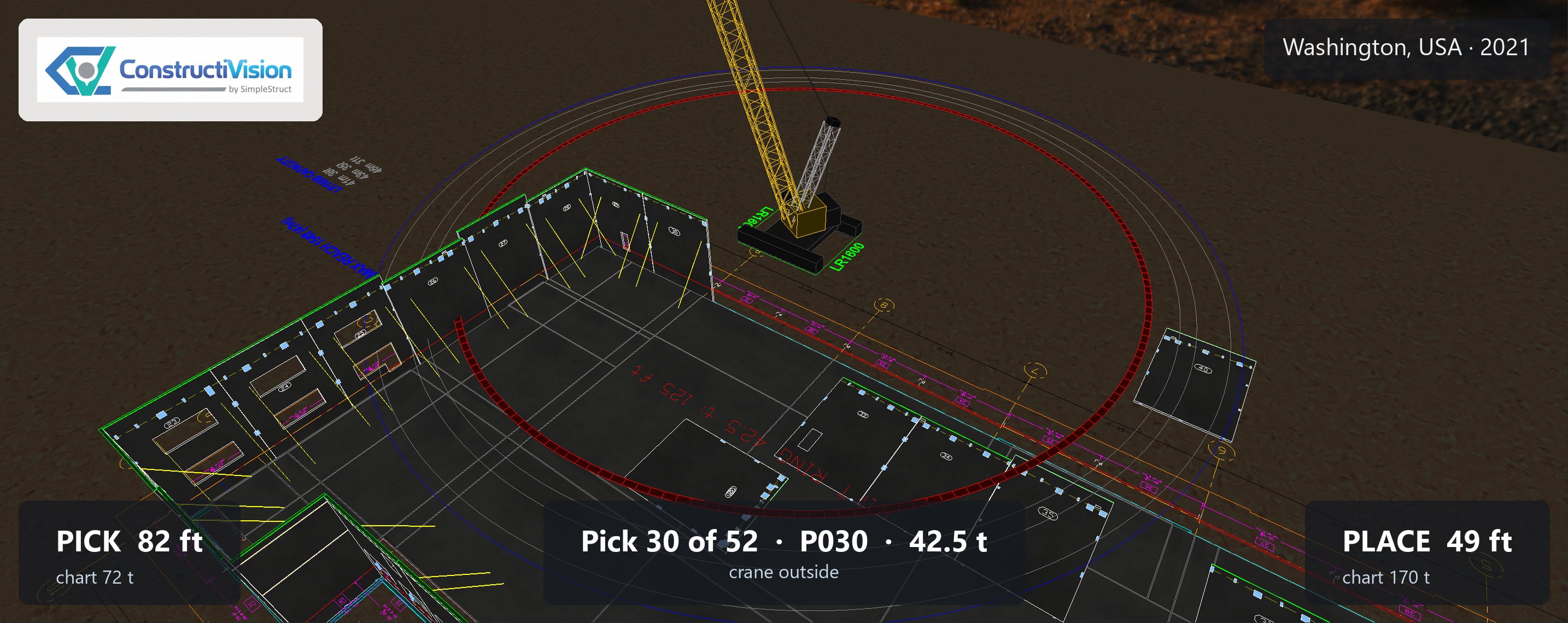
Washington, USA · 2021
A building of 52 panels, planned from the job's own records: the casting layout is the one drawn for the job; the erected site is stood up from the panel positions recorded in the job's own site drawing. Neither was generated by our planner. An LR1600 crawler makes every pick. The camera turns once around the building, shared out wall by wall, so it keeps facing the wall being set, and rises to look straight down half way through.
 Play in the player above
Open the video (MP4, 204 MB, full resolution)
The earlier video of this building, kept to show what changed. Re-scored on 6 October, net of its 11.0 t hook block, against Liebherr’s published LR 1600/2 chart: no pick over the chart (heaviest 100%).
Safety notes: read before copying anything from this video
SAFETY: this plan breaks rules that kill the crew or damage the slab. The carried panel crosses a standing panel or brace at picks 22, 27, 47, 48, 49, 50, 52; the tracks touch a standing panel, a brace or a cast panel while driving or turning at picks 2, 44; a set panel's braces land on a panel still lying cast (the drawn layout needs fixing) at picks 19, 27. Do not copy these picks. The red captions in the video name the rules checked when it was filmed. The planner is being fixed; a corrected reel will follow, and this one is kept to show the difference.
Not a sequence to copy where it breaks a safety rule: 2 picks stand closer to the panel than the panel's height (36, 46). It is found by the plan's own checks and is not fixed in this video.
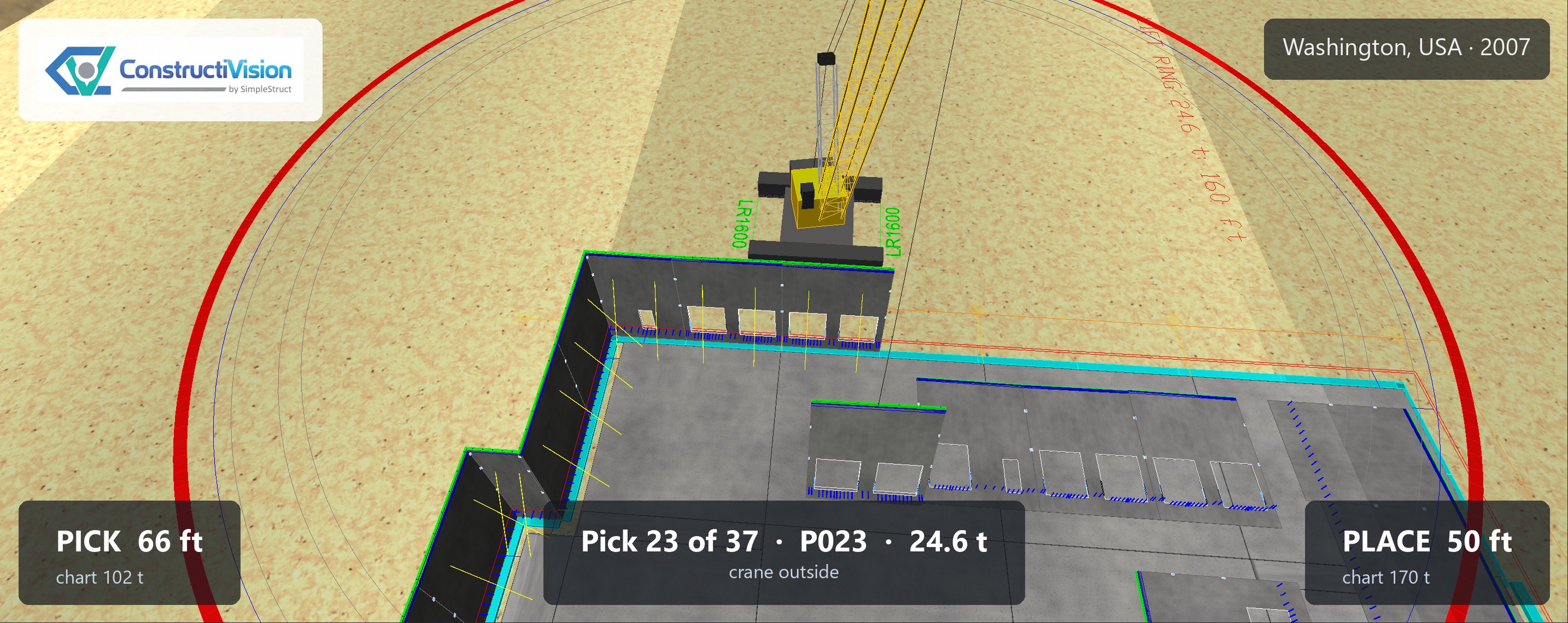
Washington, USA · 2007
A building of 37 panels, planned from the job's own records: the casting layout is the one drawn for the job; the erected site is stood up from the panel positions recorded in the job's own site drawing. Neither was generated by our planner. An LR1600 crawler makes every pick. The camera turns once around the building, shared out wall by wall, so it keeps facing the wall being set, and rises to look straight down half way through.
 Play in the player above
Open the video (MP4, 183 MB, full resolution)
The earlier video of this building, kept to show what changed. Re-scored on 6 October, net of its 11.0 t hook block, against Liebherr’s published LR 1600/2 chart: no pick over the chart (heaviest 92%).
Safety notes: read before copying anything from this video
SAFETY: this plan breaks rules that kill the crew or damage the slab. The carried panel crosses a standing panel or brace at pick 37; a set panel's braces land on a panel still lying cast (the drawn layout needs fixing) at picks 3, 4, 5, 6, 9, 10, 11, 12, 13, 14, 15, 25, 28, 29, 30, 31, 32, 33, 34, 35, 36. Do not copy these picks. The red captions in the video name the rules checked when it was filmed. The planner is being fixed; a corrected reel will follow, and this one is kept to show the difference.
Not a sequence to copy where it breaks a safety rule: 1 pick stands closer to the panel than the panel's height (20). It is found by the plan's own checks and is not fixed in this video.
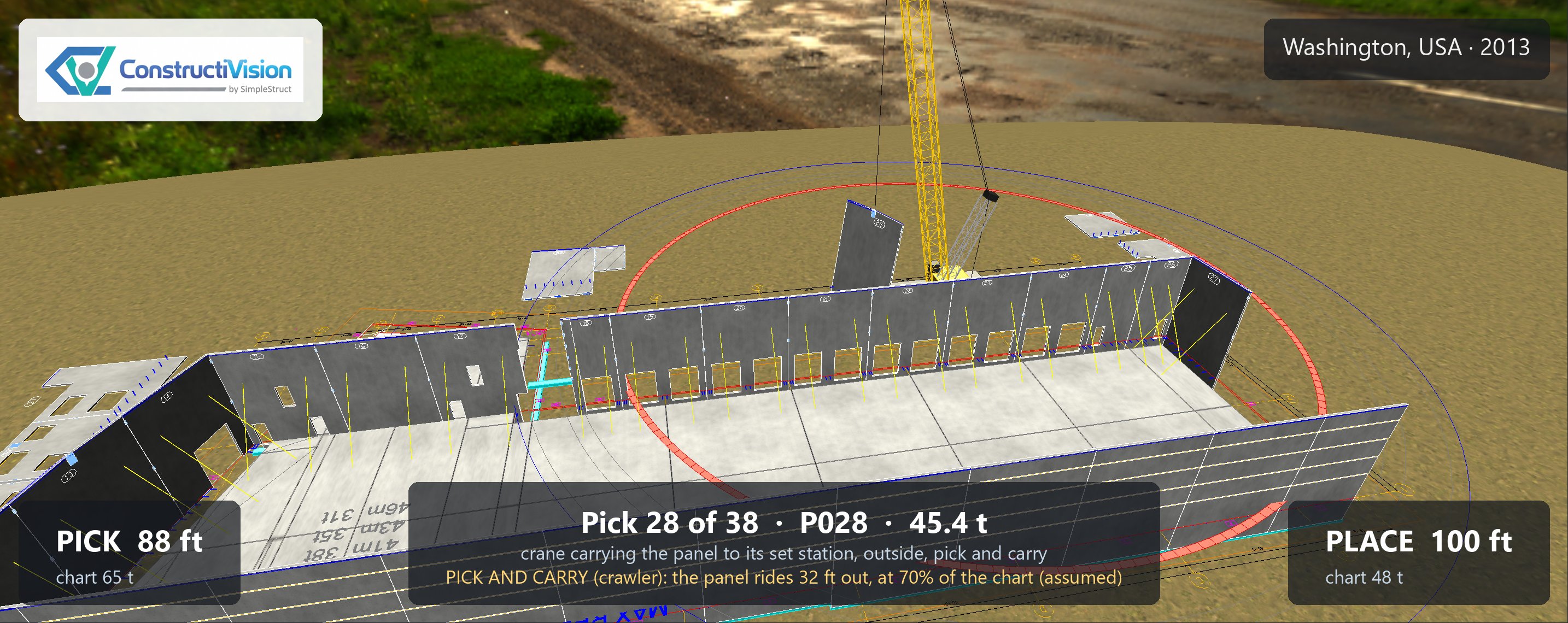
Washington, USA · 2013
A building of 38 panels, planned from the job's own records: the erected site and the casting layout are both taken from the panel positions recorded in the job's own site drawing. Neither was generated by our planner. An LR1600 crawler makes every pick. The crane leaves through the building's own 300 ft opening, and the panel beside it is set last. 6 panels no single crane position can reach are picked, carried while the crawler drives, and set from a second position (DuckD027, DuckD028, DuckD030, DuckD031, DuckD032, DuckD029). The camera turns once around the building, shared out wall by wall, so it keeps facing the wall being set, and rises to look straight down half way through.
 Play in the player above
Open the video (MP4, 241 MB, full resolution)
The earlier video of this building, kept to show what changed. Re-scored on 6 October, net of its 11.0 t hook block, against Liebherr’s published LR 1600/2 chart: no pick over the chart (heaviest 97%).
Safety notes: read before copying anything from this video
SAFETY: this plan breaks rules that kill the crew or damage the slab. The carried panel crosses a standing panel or brace at picks 4, 5, 27, 32, 33, 34, 35, 36; the crane stands closer to the panel than its height, inside the fall zone at pick 16; the tracks touch a standing panel, a brace or a cast panel while driving or turning at picks 16, 17, 32; the crane drives across the slab edge away from a ramp, with its tracks half on the slab and half off at pick 17. Do not copy these picks. The red captions in the video name the rules checked when it was filmed. The planner is being fixed; a corrected reel will follow, and this one is kept to show the difference.
Not a sequence to copy where it breaks a safety rule: 2 picks stand closer to the panel than the panel's height (14, 16). It is found by the plan's own checks and is not fixed in this video.
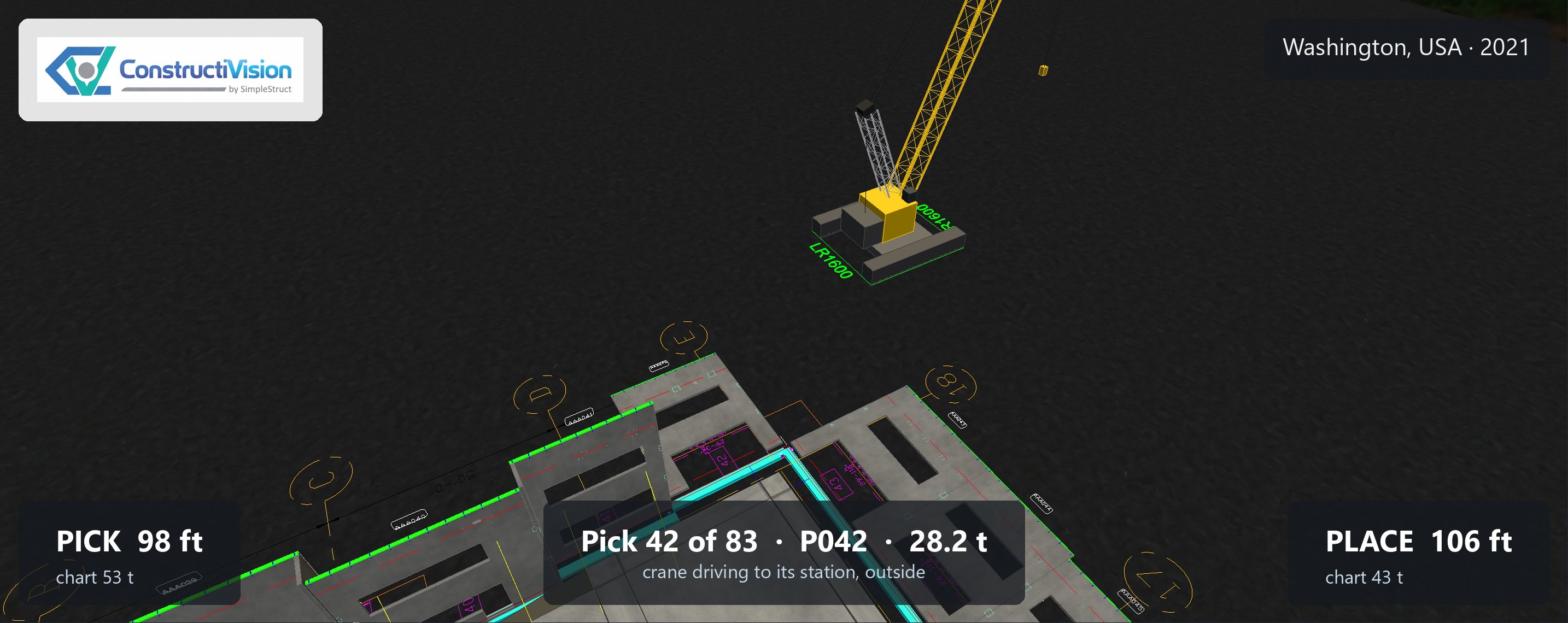
Washington, USA · 2021
A building of 83 panels. The erected site is stood up from the panel positions in the job's own site record; the casting layout is ConstructiVision's: the job's site record puts its panels on the far side of the building from their walls, so each panel is laid beside its own wall (79 outside it, 4 on the slab where the outside was taken). An LR1600 crawler makes every pick. The camera turns once around the building, shared out wall by wall, so it keeps facing the wall being set, and rises to look straight down half way through.
 Play in the player above
Open the video (MP4, 234 MB, full resolution)
The earlier video of this building, kept to show what changed. Re-scored on 6 October, net of its 11.0 t hook block, against Liebherr’s published LR 1600/2 chart: no pick over the chart (heaviest 99%).
Safety notes: read before copying anything from this video
SAFETY: this plan breaks rules that kill the crew or damage the slab. The carried panel crosses a standing panel or brace at pick 34; the tracks touch a standing panel, a brace or a cast panel while driving or turning at pick 1; a set panel's braces land on a panel still lying cast (the drawn layout needs fixing) at picks 32, 33. Do not copy these picks. The red captions in the video name the rules checked when it was filmed. The planner is being fixed; a corrected reel will follow, and this one is kept to show the difference.
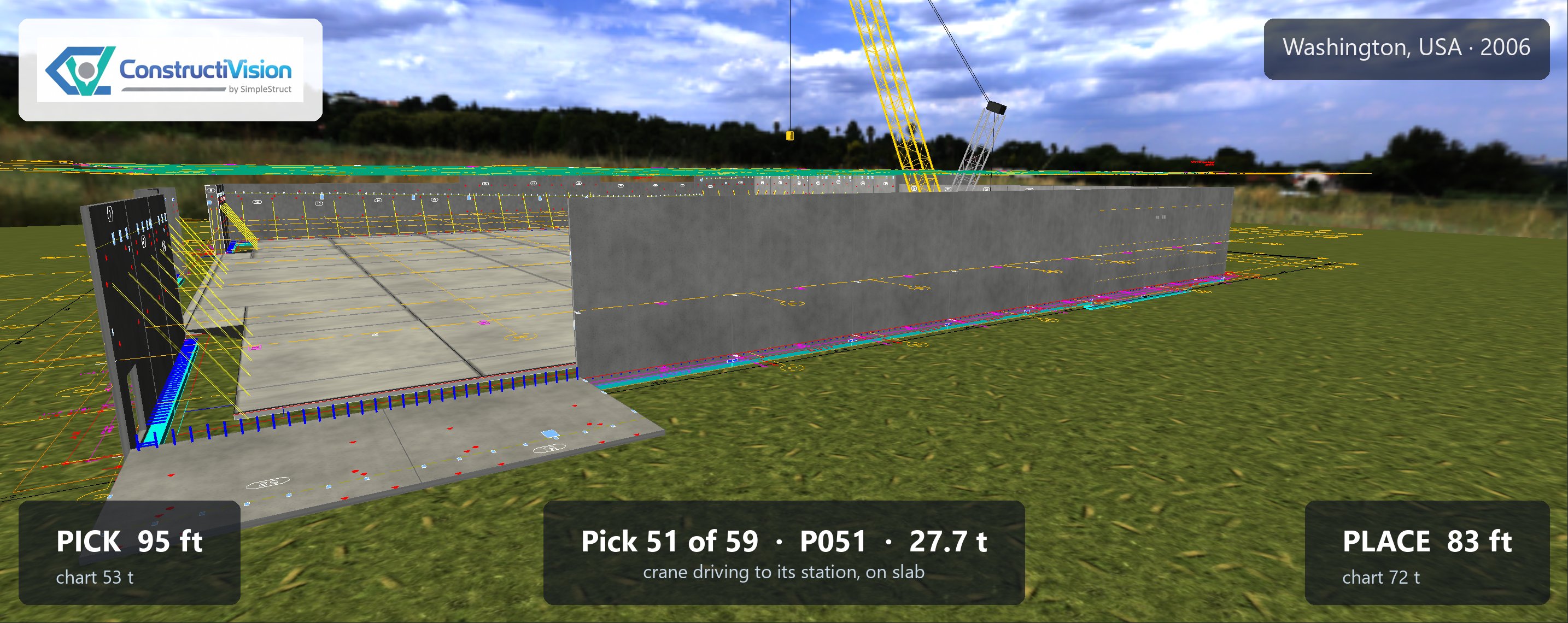
Washington, USA · 2006
A building of 59 panels. The erected site is stood up from the panel positions in the job's own site record; the casting layout is ConstructiVision's: the job's site record puts its panels on the far side of the building from their walls, so each panel is laid beside its own wall (51 outside it, 8 on the slab where the outside was taken). An LR1600 crawler makes every pick. The crane leaves through the building's own 99 ft opening, and the panel beside it is set last. The camera turns once around the building, shared out wall by wall, so it keeps facing the wall being set, and rises to look straight down half way through.
 Play in the player above
Open the video (MP4, 578 MB, full resolution)
The earlier video of this building, kept to show what changed. Re-scored on 6 October, net of its 11.0 t hook block, against Liebherr’s published LR 1600/2 chart: no pick over the chart (heaviest 99%).
Safety notes: read before copying anything from this video
SAFETY: this plan breaks rules that kill the crew or damage the slab. The carried panel crosses a standing panel or brace at pick 52; a set panel's braces land on a panel still lying cast (the drawn layout needs fixing) at picks 2, 3, 29, 30. Do not copy these picks. The red captions in the video name the rules checked when it was filmed. The planner is being fixed; a corrected reel will follow, and this one is kept to show the difference.
Washington, USA · 2010
A building of 78 panels. The erected site is stood up from the panel positions in the job's own site record; the casting layout is ConstructiVision's: the job's site record puts its panels on the far side of the building from their walls, so each panel is laid beside its own wall (74 outside it, 4 on the slab where the outside was taken). An LR1600 crawler makes every pick. The camera turns once around the building, shared out wall by wall, so it keeps facing the wall being set, and rises to look straight down half way through.
Open the video (MP4, 248 MB, full resolution)
Safety notes: read before copying anything from this video
SAFETY: this plan breaks rules that kill the crew or damage the slab. The carried panel crosses a standing panel or brace at pick 52; the tracks touch a standing panel, a brace or a cast panel while driving or turning at picks 1, 76. Do not copy these picks. The red captions in the video name the rules checked when it was filmed. The planner is being fixed; a corrected reel will follow, and this one is kept to show the difference.
Not a sequence to copy where it breaks a safety rule: Pick 78 made from behind the panel being set, where the operator cannot see the load. It is found by the plan's own checks and is not fixed in this video.
Safety check on this plan. The same independent check as above, with its crane-across-the-edge control caught first: all 78 crane positions are clear, 75 wholly on poured slab inside the closure strip and 3 wholly outside beyond the wall clearance. None is on the closure strip or across the slab edge. The closest is 71 in from the slab edge. The picks named in the SAFETY note above break the carry and boom rules.
QA check at the end of the video. With every panel standing, ConstructiVision's own interference check runs on the finished building, with its joint-gap and corner checks, and the braces are checked for poured slab under every foot, concrete under every top, and a clear path past the other panels. Every finding is drawn in red; the camera circles the outside and then the inside and stops at each one. It found 10: brace off slab ×6, braces cross ×4. They cost 38 TIQ points, whole points by severity.
The sky is a photograph. A 360° photo (Poly Haven, CC0) is the scene's lighting as well as its background, so it turns with the camera. It is not the site's real surroundings. The ground around the site is cut from the photo's own terrain and matched to its colour as it renders; beyond it the photo's own ground shows.
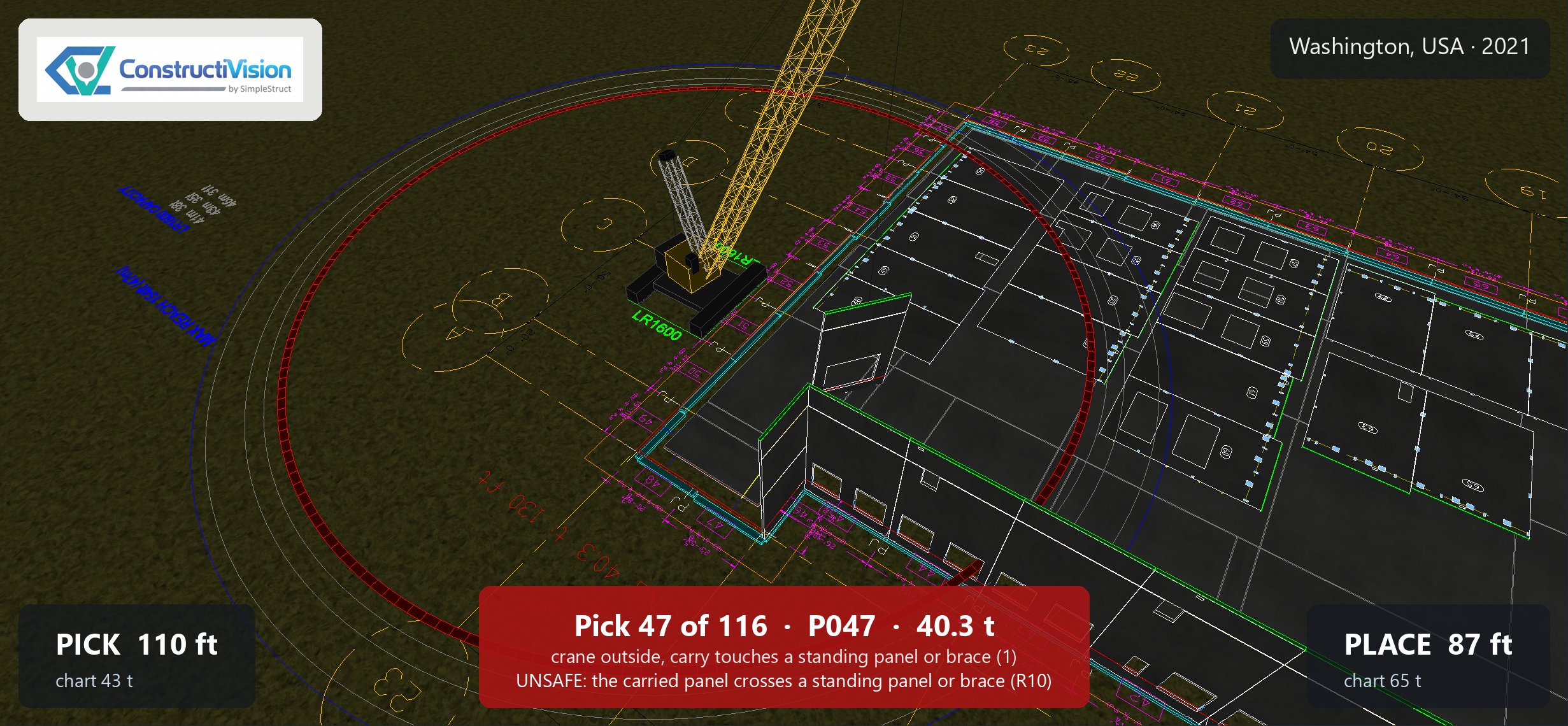
Washington, USA · 2021
A building of 116 panels, planned from the job's own records: the casting layout is the one drawn for the job; the erected site is stood up from the panel positions recorded in the job's own site drawing. Neither was generated by our planner. An LR1600 crawler makes every pick. The crane leaves through the building's own 329 ft opening, and the panel beside it is set last. 2 panels no single crane position can reach are picked, carried while the crawler drives, and set from a second position (SDNBui106, SDNBui107). The camera turns once around the building, shared out wall by wall, so it keeps facing the wall being set, and rises to look straight down half way through.
 Play in the player above
Open the video (MP4, 330 MB, full resolution)
The earlier video of this building, kept to show what changed. Re-scored on 6 October, net of its 11.0 t hook block, against Liebherr’s published LR 1600/2 chart: 27 of 116 picks over the chart (worst 315%, at picks 7, 8, 9, 10, 24, 37, 38, 50, 53, 60, 61, 63, 65, 70, 78, 82, 97, 104, 105, 108, 109, 110, 111, 112, 113, 114, 115). That video was filmed before the hook block was deducted and may not mark them.
Safety notes: read before copying anything from this video
SAFETY: at 27 of 116 picks the crane reaches too far: the panel’s centre of gravity is outside its lift ring. A lift ring is the farthest radius at which the load chart still lifts the panel’s weight. Against Liebherr’s published LR 1600/2 chart (US technical data, page 25, 217 ft S boom, 419,000 + 143,300 lb counterweight, 360°), net of its 11.0 t hook block, as the chart requires, the worst is 315% of the chart at that radius. Outside the lift ring at picks 7, 8, 9, 10, 24, 37, 38, 50, 53, 60, 61, 63, 65, 70, 78, 82, 97, 104, 105, 108, 109, 110, 111, 112, 113, 114, 115; the video was filmed before this check deducted the hook block, so its red captions may name fewer of them.
SAFETY: this plan breaks rules that kill the crew or damage the slab. The carried panel crosses a standing panel or brace at picks 47, 53, 55, 106, 108, 116; the boom crosses an erected panel at picks 24, 108, 110, 112, 114; a set panel's braces land on a panel still lying cast (the drawn layout needs fixing) at picks 5, 6, 7, 22, 45, 78, 110, 112; the panel’s centre of gravity is outside the lift ring for its weight (the crane reaches too far) at picks 7, 8, 9, 10, 24, 37, 38, 50, 53, 60, 61, 63, 65, 70, 78, 82, 97, 104, 105, 108, 109, 110, 111, 112, 113, 114, 115; the crane drives across the slab edge away from a ramp, with its tracks half on the slab and half off at pick 1. Do not copy these picks. The red captions in the video name the rules checked when it was filmed. The planner is being fixed; a corrected reel will follow, and this one is kept to show the difference.
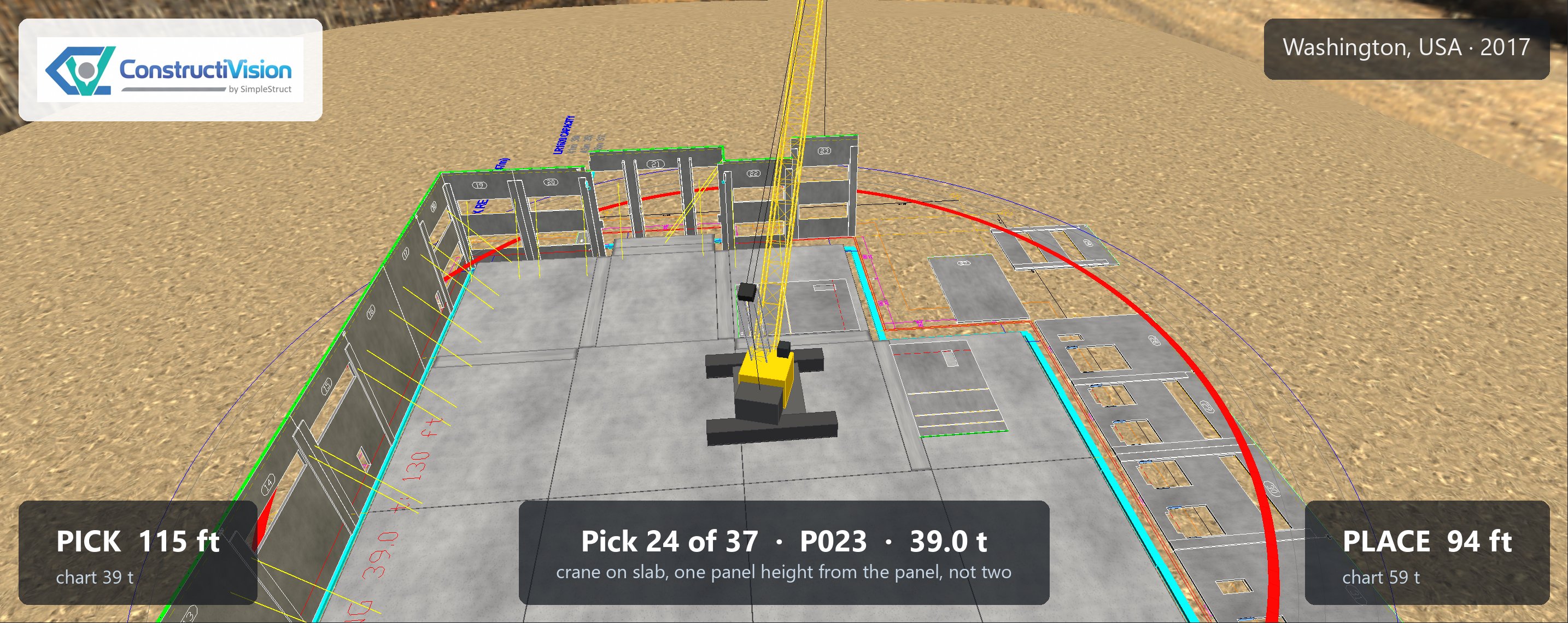
Washington, USA · 2017
A building of 37 panels. The erected site is stood up from the panel positions in the job's own site record; the casting layout is ConstructiVision's: the job's site record puts its panels on the far side of the building from their walls, so each panel is laid beside its own wall (32 outside it, 5 on the slab where the outside was taken). An LR1600 crawler makes every pick. The crane leaves through the building's own 49 ft opening, and the panel beside it is set last. The camera turns once around the building, shared out wall by wall, so it keeps facing the wall being set, and rises to look straight down half way through.
 Play in the player above
Open the video (MP4, 203 MB, full resolution)
The earlier video of this building, kept to show what changed. Re-scored on 6 October, net of its 11.0 t hook block, against Liebherr’s published LR 1600/2 chart: 1 of 37 picks over the chart (worst 122%, at pick 25). That video was filmed before the hook block was deducted and may not mark it.
Safety notes: read before copying anything from this video
SAFETY: at 1 of 37 picks the crane reaches too far: the panel’s centre of gravity is outside its lift ring. A lift ring is the farthest radius at which the load chart still lifts the panel’s weight. Against Liebherr’s published LR 1600/2 chart (US technical data, page 25, 217 ft S boom, 419,000 + 143,300 lb counterweight, 360°), net of its 11.0 t hook block, as the chart requires, the worst is 122% of the chart at that radius. Outside the lift ring at pick 25; the video was filmed before this check deducted the hook block, so its red captions may name fewer of them.
SAFETY: this plan breaks rules that kill the crew or damage the slab. The carried panel crosses a standing panel or brace at picks 27, 36; the crane stands closer to the panel than its height, inside the fall zone at pick 22; the tracks touch a standing panel, a brace or a cast panel while driving or turning at picks 1, 22, 25; a set panel's braces land on a panel still lying cast (the drawn layout needs fixing) at picks 20, 22; the panel’s centre of gravity is outside the lift ring for its weight (the crane reaches too far) at pick 25. Do not copy these picks. The red captions in the video name the rules checked when it was filmed. The planner is being fixed; a corrected reel will follow, and this one is kept to show the difference.
Not a sequence to copy where it breaks a safety rule: 1 pick stands closer to the panel than the panel's height (22). It is found by the plan's own checks and is not fixed in this video.
Washington, USA · 2016
A building of 98 panels, planned from the job's own records: the casting layout is the one drawn for the job; the erected site is stood up from the panel positions recorded in the job's own site drawing. Neither was generated by our planner. An LR1600 crawler makes every pick. The crane leaves through the building's own 387 ft opening, and the panel beside it is set last. 6 panels no single crane position can reach are picked, carried while the crawler drives, and set from a second position (SegalP15001, SegalP15025, SegalP15026, SegalP15039, SegalP15040, SegalP15072). The camera turns once around the building, shared out wall by wall, so it keeps facing the wall being set, and rises to look straight down half way through.
Open the video (MP4, 366 MB, full resolution)
Safety notes: read before copying anything from this video
SAFETY: at 1 of 98 picks the crane reaches too far: the panel’s centre of gravity is outside its lift ring. A lift ring is the farthest radius at which the load chart still lifts the panel’s weight. Against Liebherr’s published LR 1600/2 chart (US technical data, page 25, 217 ft S boom, 419,000 + 143,300 lb counterweight, 360°), net of its 11.0 t hook block, as the chart requires, the worst is 203% of the chart at that radius. Outside the lift ring at pick 1; the video was filmed before this check deducted the hook block, so its red captions may name fewer of them.
SAFETY: this plan breaks rules that kill the crew or damage the slab. The carried panel crosses a standing panel or brace at picks 29, 40, 41, 72, 87, 97; there is no hook room over the standing panels at picks 3, 73; the crane stands closer to the panel than its height, inside the fall zone at picks 1, 2, 4, 5, 6, 7, 8, 9, 10, 11, 12, 13, 14, 15, 16, 17, 18, 19, 20, 21, 22, 23, 24, 25, 26, 27, 29, 30, 31, 32, 33, 34, 35, 36, 37, 40, 42, 43, 44, 45, 46, 47, 48, 49, 50, 51, 52, 53, 54, 55, 56, 57, 58, 59, 61, 62, 63, 64, 65, 66, 67, 68, 69, 70, 74, 75, 77, 78, 79, 80, 82, 83, 84, 85, 86, 87, 96; the tracks touch a standing panel, a brace or a cast panel while driving or turning at picks 1, 2, 3, 5, 72, 86, 87; a set panel's braces land on a panel still lying cast (the drawn layout needs fixing) at picks 2, 29, 30, 31, 32, 33, 34, 35, 36, 37, 38, 39, 40, 42, 43, 73, 74, 75, 76, 78, 79, 81, 82, 83, 84, 85, 86, 89, 92, 94; the panel’s centre of gravity is outside the lift ring for its weight (the crane reaches too far) at pick 1. Do not copy these picks. The red captions in the video name the rules checked when it was filmed. The planner is being fixed; a corrected reel will follow, and this one is kept to show the difference.
Not a sequence to copy where it breaks a safety rule: 71 picks stand closer to the panel than the panel's height (4, 5, 6, 7, 8, 9, 10, 11, 12, 13, 14, 15, 16, 17, 18, 19, 20, 21, 22, 23, 24, 25, 26, 30, 31, 32, 33, 34, 35, 36, 37, 42, 43, 44, 45, 46, 47, 48, 49, 50, 51, 52, 53, 54, 55, 56, 57, 58, 59, 61, 62, 63, 64, 65, 66, 67, 68, 69, 70, 74, 75, 77, 78, 79, 80, 82, 83, 84, 85, 86, 96). It is found by the plan's own checks and is not fixed in this video.
Safety check on this plan. The same independent check as above, with its crane-across-the-edge control caught first: all 103 crane positions are clear, 103 wholly on poured slab inside the closure strip and 0 wholly outside beyond the wall clearance. None is on the closure strip or across the slab edge. The closest is 267 in from the slab edge. The picks named in the SAFETY note above break the carry and boom rules.
The sky is a photograph. A 360° photo (Poly Haven, CC0) is the scene's lighting as well as its background, so it turns with the camera. It is not the site's real surroundings. The ground around the site is cut from the photo's own terrain and matched to its colour as it renders; beyond it the photo's own ground shows.
Still open: Some carries still touch a standing panel or brace briefly.
How every pick is checked
Not checked yet: clearance between the boom and panels already standing, and whether the ground beside a wall is available for casting. The carry is checked in plan, and a few carries still touch a standing panel or brace briefly on every move: 3 of the 2020 Washington building's 83 picks.
Read more
- Never straddling the slab edge. A station is accepted only if its full track footprint lies wholly on poured slab inside the closure strip, or wholly outside the building beyond the wall clearance. Only the first pick may reduce the wall clearance, and then its footprint must stay clear of every footing. Measured independently on both plans above: 0 of 159 stations on the closure strip or across the slab edge.
- Tracks parallel to the nearest wall. At every stop the tracks run along the nearest wall, the way the crane travels. The footprint is checked in that direction, so the narrow side of the machine faces the wall.
- Clear of everything on the ground. The footprint must not sit on a panel lying cast, a panel already standing, or its braces, and the counterweight's swing clears every standing panel.
- Inside the load chart with margin. Both the pick and set radii must be inside the crane's published chart. The planner looks first for stations where the chart carries at least 1.25× the panel's weight, because that weight does not include the rigging.
- The cast layout is checked for clashes. AutoCAD's own interference check runs on the cast panels, and every panel must lie wholly on the pour or wholly beyond the wall clearance. No two cast panels overlap on either building.
- The carry goes round the crane. The crane swings the load the short way first, at the smaller radius, and goes the long way round only when the short way is already 135° or more. It uses the first move whose carried panel stays clear of the crane, the standing panels and their braces. The panel itself turns the short way, a little at a time.
- The crane drives, it does not jump. Between stations it travels along its tracks on straight legs, turning in place. Its whole track footprint is checked every 3 ft of the way against panels lying cast, standing panels and braces, and it stays on the poured slab.
- Panels come up facing the right way. Each panel is cast so it tilts up about its bottom edge already facing the way it stands. The crane only carries it back to its footing.
Earlier versions
Kept so the progress between versions can be seen.
Read more
- Washington 2020 building, version 3 (MP4, 10.8 MB), 23 September, top down. The crane carries each panel in a straight line.
See what ConstructiVision does today
The construction planner is being built on top of the shipping AutoCAD plug-in and its panel data.